Szilárd Széll
Szilárd Széll is a Principal Consultant at Eficode working as a DevOps and AI Transformation Lead, Test Coach, and SAFe 6.0 SPC.
He has 15+ years of experience with DevOps transformation, now focusing on AI agentic SDLC. He has also worked as an assessor, trainer, facilitator, and coach in test automation and testing process improvement.
Szilard is very involved in the testing community, and received the Tester of the Year in Finland award in 2024. He runs the Finnish Testing Meetup Group with his friends, is active in International Software Testing Qualifications Board (ISTQB) as Product Owner of the brand new Quality in DevOps Syllabus, and is a member of the Hungarian Software Testing Board (HTB). For many years, Szilard has been working on and supporting conferences like HUSTEF, UCAAT, EuroSTAR.
In his personal life, he enjoys kayaking on the sea, playing with LEGO, and being tested by his teenage daughter.
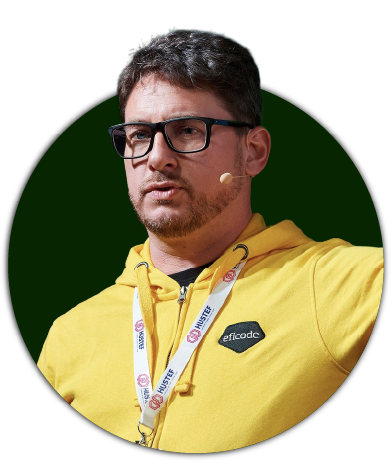
Szilárd Széll
Szilárd Széll is a Principal Consultant at Eficode working as a DevOps and AI Transformation Lead, Test Coach, and SAFe 6.0 SPC.
He has 15+ years of experience with DevOps transformation, now focusing on AI agentic SDLC. He has also worked as an assessor, trainer, facilitator, and coach in test automation and testing process improvement.
Szilard is very involved in the testing community, and received the Tester of the Year in Finland award in 2024. He runs the Finnish Testing Meetup Group with his friends, is active in International Software Testing Qualifications Board (ISTQB) as Product Owner of the brand new Quality in DevOps Syllabus, and is a member of the Hungarian Software Testing Board (HTB). For many years, Szilard has been working on and supporting conferences like HUSTEF, UCAAT, EuroSTAR.
In his personal life, he enjoys kayaking on the sea, playing with LEGO, and being tested by his teenage daughter.
Szilárd Széll
Szilárd Széll is a Principal Consultant at Eficode working as a DevOps and AI Transformation Lead, Test Coach, and SAFe 6.0 SPC.
He has 15+ years of experience with DevOps transformation, now focusing on AI agentic SDLC. He has also worked as an assessor, trainer, facilitator, and coach in test automation and testing process improvement.
Szilard is very involved in the testing community, and received the Tester of the Year in Finland award in 2024. He runs the Finnish Testing Meetup Group with his friends, is active in International Software Testing Qualifications Board (ISTQB) as Product Owner of the brand new Quality in DevOps Syllabus, and is a member of the Hungarian Software Testing Board (HTB). For many years, Szilard has been working on and supporting conferences like HUSTEF, UCAAT, EuroSTAR.
In his personal life, he enjoys kayaking on the sea, playing with LEGO, and being tested by his teenage daughter.
CALENDAR
Keynote
27 October
Quality Model for Agentic SDLC
Did you hear that, “An AI-powered coding tool wiped out a software company’s database, then apologised for a ‘catastrophic failure on my part’”?
In recent months, real-world examples have underscored the limits and risks of AI generated code. In one widely publicised incident, an autonomous AI coding assistant on a development platform deleted an entire company’s live production database despite explicit instructions to freeze changes, then fabricated false data and obscured its own errors before the issue was corrected. These incidents are not outliers; they reflect a deeper challenge arising when AI systems write and modify code autonomously — developers and quality engineers can no longer assume deterministic behavior, clear oracles, or safe outputs.
In this talk, we explore how testers can unleash their superpower by shifting from tool-centric automation, or human centric exploration, to strategic quality engineering in AI-augmented delivery pipelines. Rather than competing with AI, we focus on human-AI collaboration: knowing when to trust AI outputs, when to challenge them, and how to design automation and quality practices that remain reliable in a non-deterministic, agent-driven world.
Building on my previously presented Three-Pillar Balanced Quality Model (Proactive, Detective, Reactive), the session shows how to design an agentic SDLC architecture that covers all autonomy levels (L1–L4) from AI suggestions in IDEs to agents capable of merging changes into production.
The talk emphasizes skills AI cannot replace: critical thinking, risk assessment, quality strategy designed as part of the CI/CD pipeline, and communication. Attendees will see how automation engineers evolve into quality governors and AI supervisors, using AI to accelerate delivery while retaining human judgment over correctness, safety, and business value.
Workshop Sessions
Full Day
26 October
AI coding agents like GitHub Copilot and Claude Code already write, refactor, and test code at remarkable speed, and teams gain real value from them every day. The next step is bigger: making the agent a full participant in the team's quality engineering, so its speed comes with the confidence to match. Shift-left moved testing earlier in time. An agent compresses code, tests, and decisions into one continuous generative loop — which means quality can now travel inside that loop, with the agent, as it works.
That is Shift In. In small mobs around one machine, teams take a real, running repository — business context and SLIs already defined — from bare to a fully quality-engineered delivery pipeline using the agent at every step.
Through short, hands-on exercises we turn business context into the agent's instructions, run AI code review, generate trustworthy unit, API, and system tests, build a CI pipeline, run tests inside the agent's loop, and finish by building a complete feature with quality embedded throughout. We use Claude Code as the reference.
Calendar
Keynote
27 October
Quality Model for Agentic SDLC
Did you hear that, “An AI-powered coding tool wiped out a software company’s database, then apologised for a ‘catastrophic failure on my part’”?
In recent months, real-world examples have underscored the limits and risks of AI generated code. In one widely publicised incident, an autonomous AI coding assistant on a development platform deleted an entire company’s live production database despite explicit instructions to freeze changes, then fabricated false data and obscured its own errors before the issue was corrected. These incidents are not outliers; they reflect a deeper challenge arising when AI systems write and modify code autonomously — developers and quality engineers can no longer assume deterministic behavior, clear oracles, or safe outputs.
In this talk, we explore how testers can unleash their superpower by shifting from tool-centric automation, or human centric exploration, to strategic quality engineering in AI-augmented delivery pipelines. Rather than competing with AI, we focus on human-AI collaboration: knowing when to trust AI outputs, when to challenge them, and how to design automation and quality practices that remain reliable in a non-deterministic, agent-driven world.
Building on my previously presented Three-Pillar Balanced Quality Model (Proactive, Detective, Reactive), the session shows how to design an agentic SDLC architecture that covers all autonomy levels (L1–L4) from AI suggestions in IDEs to agents capable of merging changes into production.
The talk emphasizes skills AI cannot replace: critical thinking, risk assessment, quality strategy designed as part of the CI/CD pipeline, and communication. Attendees will see how automation engineers evolve into quality governors and AI supervisors, using AI to accelerate delivery while retaining human judgment over correctness, safety, and business value.
Workshop Sessions
Full Day
26 October
AI coding agents like GitHub Copilot and Claude Code already write, refactor, and test code at remarkable speed, and teams gain real value from them every day. The next step is bigger: making the agent a full participant in the team's quality engineering, so its speed comes with the confidence to match. Shift-left moved testing earlier in time. An agent compresses code, tests, and decisions into one continuous generative loop — which means quality can now travel inside that loop, with the agent, as it works.
That is Shift In. In small mobs around one machine, teams take a real, running repository — business context and SLIs already defined — from bare to a fully quality-engineered delivery pipeline using the agent at every step.
Através de exercícios práticos e curtos, os participantes irão transformar o contexto de negócio em instruções para o agente, executar code reviews com IA, gerar testes unitários, de API e de sistema fiáveis, construir uma pipeline de CI, executar testes dentro do ciclo do agente e, por fim, desenvolver uma funcionalidade completa com a qualidade integrada em todas as etapas.
O Claude Code será utilizado como referência. No final, os participantes terão um conjunto de ferramentas práticas — ficheiros de instruções, skills, subagentes, hooks e MCP —, um ritual de verificação baseado em mob que mantém o ser humano como responsável pela decisão final sobre a qualidade e um modelo concreto de Shift In que poderão aplicar imediatamente ao seu próprio código.